


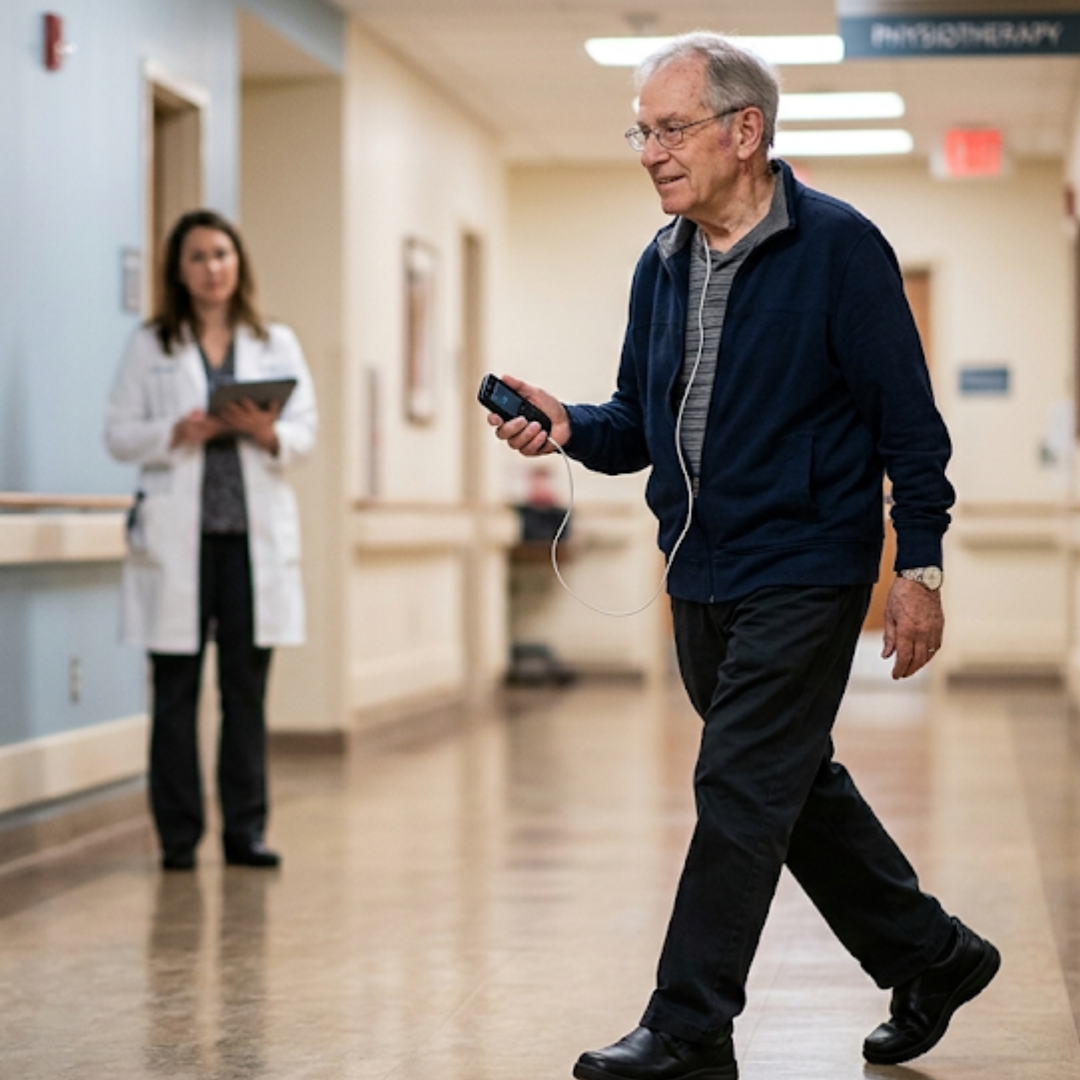
Smart deep brain stimulation devices now read brain signals in real time to automatically adjust electrical pulses and help people walk more smoothly
June 16, 2026
Deep brain stimulation has been a highly effective way to manage Parkinson's for decades, especially when it comes to reducing tremors and stiffness. Traditional systems work like a standard pacemaker, sending a constant, fixed stream of electrical pulses to specific areas of the brain. While this unmoving signal works wonders for resting symptoms, it often falls short when a person tries to move around. Moving through daily life involves a complex mix of actions such as standing up, walking in a straight line, turning corners, and avoiding obstacles. Each of these movements requires the brain and muscles to work in entirely different ways. Because traditional stimulation cannot change on the fly, it sometimes fails to help with walking difficulties and can occasionally even make balance issues or frozen steps worse.
To overcome this limitation, a team of researchers developed an intelligent upgrade called activity dependent adaptive deep brain stimulation. Instead of firing the exact same electrical pulse all day long, this smart system listens to the brain. It uses advanced artificial intelligence to read the unique electrical patterns, or biomarkers, inside the brain that change whenever a person shifts from resting to moving.
By analyzing data from forty people, the researchers successfully trained artificial intelligence to decode these brain signals in real time. The intelligent system can figure out exactly what kind of movement a person is making or trying to make, whether that is standing still, walking, or turning. Once the system identifies the activity, it automatically alters the electrical stimulation settings within seconds. This rapid adjustment ensures that the brain receives the precise level of support it needs for the specific action being performed at that exact moment.
The real world benefits of this responsive approach are highly encouraging. Participants in the study reported that their legs felt significantly less heavy and that they experienced fewer unpredictable, uncontrollable movements. By adapting to daily activities as they happen, the technology allowed people to walk with much greater ease, navigate tricky tasks like climbing stairs, and cover longer distances comfortably. Because this breakthrough builds directly upon existing, clinically approved brain stimulation implants, it marks a practical and highly promising step toward turning brain stimulation into a truly intuitive therapy that moves with you.
Comments (0)
Loading comments...